


Unlocking Greater Value: Food Byproducts and Sustainable Solutions in California 2026
California’s agricultural landscape is driving renewed attention to food byproducts as practical inputs for ingredient innovation and circular supply chains. In 2026, food byproducts are the focal point for processors seeking to capture additional value from almond hulls, whey, rice bran, and olive pulp. This article examines technical requirements, regulatory pathways, and commercial trade-offs for converting secondary streams into food-grade ingredients.
Why food byproducts matter for system-level sustainability
Repurposing food byproducts can lower waste, conserve resources, and open new revenue streams across agricultural value chains. When processors convert side streams into ingredient-grade materials, they reduce landfill diversion and create opportunities to displace primary-resource inputs. These benefits depend on rigorous specification, safety controls, and commercial viability. Sustainable progress in this sector aligns with the trends described in the Complementary and Alternative Medicine Market Trends and Sustainable Growth Insights 2026, providing a forward-looking perspective on green innovation.
How California food byproducts are being reimagined for ingredient markets
California processors are applying engineering and food science to upgrade byproduct streams into functional inputs. Advances in sorting, microbiological control, and milling enable scales of operation that make ingredient-grade supply realistic. Real-world pilots show potential for improved moisture handling, texture modification, and nutritional contribution in baked goods and formulations.
Practical experiences from this sector mirror the wider movement in Herbal Extract Market Expansion: Best Organic Trends and Future Insights 2026, showcasing how byproduct valorization fits within broader ingredient innovation.
For further context on sector case studies and strategy, see this industry review: NewFood Magazine analysis.
Practical pathways from farm residue to ingredient-grade materials
Converting agricultural residues into food-grade inputs requires layered controls and documented validation. Key technical stages include source segregation, foreign-material exclusion, drying and water-activity management, particle size standardization, and contaminant monitoring. Processors must design controls for seasonality and varietal variation to deliver consistent lots to formulation teams.
The growing focus on clean, functional ingredients represents an evolution similar to developments in Liquid Herbal Supplements: Bioavailability, Tradition, and the Future of Clean Wellness 2026.
Source segregation and identity assurance to protect ingredient integrity
The first line of defense is segregating material streams at harvest and receiving. Accurate identity verification prevents mixing of non-target crops and reduces the risk of foreign-material contamination. Maintaining traceability from field to finished lot is critical for supply chain transparency and buyer confidence.
Cleaning, sorting, and particle engineering for predictable functionality
Advanced optical sorters, aspirators, and milling protocols are used to remove stones, sticks, and non-food debris and to produce consistent particle distributions. For example, finely milled hull powders can be optimized for water-holding capacity, mouthfeel, and particle mouthfeel, enabling predictable incorporation into cereal bars or bakery mixes. These approaches align with the attention to bioactive ingredient optimization evident from Ashwagandha and Adaptogens: Best Organic Applications & Bioavailability Insights for 2026.
Microbiological, mycotoxin, and contaminant management
Comprehensive testing programs monitor microbiological counts, mycotoxin loads, pesticide residues, and heavy metal levels. Controlling moisture and water activity during storage, plus validated thermal or non-thermal decontamination steps where required, reduces risk and supports ingredient shelf stability. These controls are central for gaining buyer acceptance.
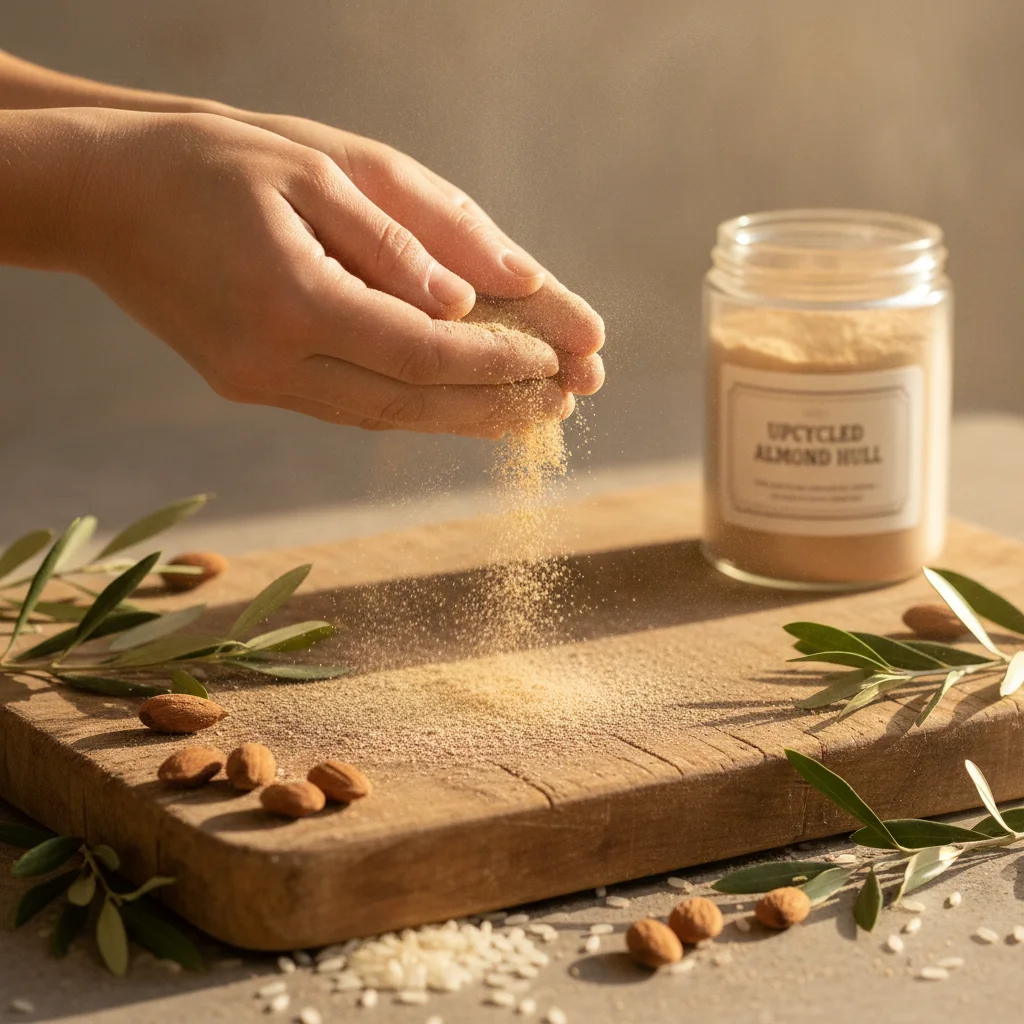
Almond hull powder as a case study in functionality and control
Almond hull powder (AHP) illustrates both the promise and the complexity of elevating a byproduct to ingredient status. Select hull material contains fiber, minerals, and phytonutrients that can contribute structure and subtle flavor to whole-grain products. However, integration requires strict allergen controls, compositional standardization, and validated cleaning.
AHP can support moisture balance and texture in baked products when formulation teams account for fiber’s effects on hydration and baking kinetics. Successful commercialization depends on processing specifications for particle size, moisture, and contaminant thresholds that align with food safety programs and supply contracts. These insights parallel the evolution of functional, clean-label ingredients seen in the Immune Health Supplements Market Outlook 2026: Bioavailable, Organic & Non-GMO Trends.
For industry case material and sector perspectives, review this article: NewFood Magazine analysis.
Regulatory and safety considerations for ingredient acceptance
Novel or upcycled materials intended for human food use require regulatory clarity and documented safety assessment. In the U.S., many ingredients follow Generally Recognized As Safe (GRAS) evaluation processes when use levels and composition are well characterized. International jurisdictions have different assessment criteria and documentation requirements that must be addressed for export markets.
Allergen management is essential when processing materials from tree nuts or other allergenic crops. Processes should prevent kernel contamination and cross-contact, backed by testing and validated cleaning regimens. Clear labeling and supply chain documentation support downstream manufacturers in meeting their own compliance obligations. Documentation and transparency also echo trends outlined in Renetta M. Cheston: Transforming Holistic Healing Practices for 2026.
Commercial calculus: when higher-value food use makes sense
Not every stream benefits from conversion to a food ingredient. Businesses weigh additional sorting, processing, energy, and regulatory costs against potential price premiums and market demand. For some materials, returning organic matter to soil or routing streams to animal feed remains the most sustainable and economical choice.
A successful commercial case typically requires:
- Demonstrable functional benefits in formulations.
- Scalable processing that preserves safety and consistency.
- Market demand for differentiated attributes such as organic, non-GMO, or specific nutrient claims. These differentiators are increasingly relevant, as discussed in Are Daily Supplements Overhyped? 2026 Guide for Informed Choices.
Scaling supply chains: contracts, traceability, and shared investment
Scaling ingredient-grade byproducts relies on transparent contracting between growers, processors, and ingredient buyers. Shared investments in cleaning, storage, and logistics can lower unit costs and distribute risk. Clear specifications, lot-based traceability, and independent testing build buyer trust and unlock longer-term purchase agreements. Robust traceability and lot-level assurance connect with the transparency measures detailed in Exploring Six Centuries of Herbal Wisdom: The Roots of Healing for 2026.
Environmental trade-offs and life-cycle perspective
Assessing food byproducts’ value requires system-level life-cycle thinking. Analysts must compare the environmental impacts of advanced processing (water, energy, transport) with the avoided impacts of displacing primary ingredients or diverting waste from landfill. In many cases, modest processing combined with local markets yields the best balance of environmental and economic benefits.

Commercial examples of value capture across the chain
When byproducts achieve food-grade status and meet functionality needs, value is shared across the chain. Growers can command better returns for segregated, high-quality streams. Ingredient processors capture margin for processing and specification services. Food manufacturers gain formulation options and potential marketing differentiation. These collaborative models reflect the principles of sector-wide sustainability illuminated in Advancing Pharmaceutical Science Education: 2026 Insights on Organic, Sustainable Innovation.
Roadmap for businesses evaluating byproduct upcycling
A pragmatic roadmap helps determine whether to pursue ingredient-grade conversion:
- Characterize the stream: composition, variability, and contaminants.
- Run small-scale formulation trials to test functionality and sensory impact.
- Map regulatory pathways and documentation needs for target markets.
- Model full-cost economics including processing capital and operating costs.
- Pilot supply chain logistics, traceability, and testing protocols.
This staged approach reduces risk and creates evidence for commercial scaling.
For a succinct sector review and implementation examples, consult this industry resource: NewFood Magazine analysis.
Conclusion: strategic, safety-first upcycling unlocks practical gains
Food byproducts represent a tangible opportunity to improve resource efficiency and create new ingredient markets in California and beyond. Realizing that opportunity rests on rigorous safety controls, predictable functionality, and a clear commercial rationale. When these conditions align, upcycled ingredients can be a meaningful component of more circular and resilient food systems in 2026 and forward.
Explore strategic options for integrating upcycled, organic, or non-GMO byproducts into your product portfolio. Start with a technical assessment and pilot testing to validate functionality and safety, then scale with documented supply agreements and traceability systems.
FAQs
-
1. What are the primary technical hurdles for converting agricultural streams into food-grade ingredients?
Key hurdles include removing foreign material, controlling moisture and water activity, standardizing particle size, and ensuring contaminant and microbiological specifications are met. The importance of consistency and validation in these processes is also echoed in Herbal Extract Market Expansion: Best Organic Trends and Future Insights 2026.
-
2. How does allergen management affect upcycling nut-related byproducts?
Allergen management is critical because hull and shell streams can contain kernel fragments or proteins with IgE reactivity. Facilities must implement segregation, validated cleaning, cross-contact controls, and targeted testing. Transparent supplier documentation and labeling practices help downstream users manage allergen risk. This mirrors practices found in the broader supplement industry, as discussed in Are Daily Supplements Overhyped? 2026 Guide for Informed Choices.
-
3. What regulatory steps are commonly required for new ingredient-grade byproducts in the U.S.?
In the U.S., new food ingredients often follow GRAS evaluation pathways when use levels and composition are well characterized. Processors prepare safety dossiers, exposure estimates, and testing results to support expert review. Insights into the international context can be found in Complementary and Alternative Medicine Market Trends and Sustainable Growth Insights 2026.
-
4. When is upcycling a byproduct into a human food ingredient not the best option?
Upcycling may not be optimal when processing costs, energy use, or contaminant risk outweigh the market value. Established uses such as animal feed, soil amendment, or biomass energy can offer greater environmental or economic returns. A life-cycle assessment helps determine the best pathway.
-
5. Which processing technologies most influence ingredient functionality?
Optical sorters, aspirators, controlled drying, milling, and sieving critically shape particle size distribution, moisture content, and purity. These attributes directly affect water-binding, texture, and sensory outcomes in finished products and are essential for repeatable performance.
-
6. How should businesses price and commercialize upcycled ingredients?
Pricing must account for incremental processing, testing, documentation, and logistics. Successful commercialization also depends on convincing buyers of consistent functional benefits. Often, pilot supply agreements and co-investment in processing infrastructure help bridge early-stage cost gaps.
-
7. What sustainability metrics are important when evaluating byproduct pathways?
Important metrics include greenhouse gas emissions, water and energy use per unit of functional ingredient, diversion from landfill, and displacement of primary ingredient production. Comparing these across alternative uses identifies the most sustainable and cost-effective option.
-
8. How can small processors participate in byproduct ingredient markets?
Small processors can collaborate with third-party standardizers, join cooperatives for shared processing equipment, or partner with established ingredient handlers for sorting and certification. These arrangements reduce capital burden while enabling access to larger buyers.
-
9. What documentation supports buyer confidence in upcycled ingredients?
Buyers expect lot-based test reports for microbiology, mycotoxins, heavy metals, and pesticide residues, plus traceability records, processing specifications, and allergen control documentation. Independent third-party audits or certifications further strengthen confidence. These standards align with practices shared in Renetta M. Cheston: Transforming Holistic Healing Practices for 2026.
-
10. How long does it typically take to move a byproduct from pilot to commercial ingredient?
The timeline varies: basic pilots with compatible functionality can move in 12–24 months, while novel streams requiring new safety data, equipment investment, or regulatory review can take multiple years. Clear milestones for technical validation and market development speed the process.