

Moringa Leaf Powder: 2026 Market Growth, Sustainable Sourcing, and Bioavailable Nutrition
Moringa Leaf Powder: Transforming Plant-Based Nutrition and Sustainable Supply Chains in 2026
Moringa leaf powder is central to a rising wave of plant-based ingredient adoption across food, personal care, and formulation industries. In this market-focused analysis, moringa leaf powder appears as both a versatile raw material and an ingredient increasingly engineered for bioavailability and supply integrity. Stakeholders are prioritizing sustainably sourced powders with documented processing methods, meeting demand for traceability and clean-label narratives.
Moringa Leaf Powder Market Trends Shaping Sourcing and Formulation Decisions
Market dynamics for moringa leaf powder center on three interlinked trends: sustainable sourcing, improved nutrient retention through processing, and demand for value-added formats. Suppliers are responding with traceability programs and low-temperature processing that preserve sensitive phytonutrients. These shifts enable formulators to select moringa powders optimized for specific product classes while meeting consumer expectations around sustainability and provenance.
Encapsulation and Format Innovation for Improved Product Integration
Encapsulation and ready-to-use formats make moringa leaf powder easier to dose, blend, and integrate into modern formulations. Encapsulated formats provide consistent portioning and protect sensitive constituents during storage and handling. For manufacturers, these formats reduce variability and support predictable ingredient performance across batches.
Benefits of Encapsulated and Ready-to-Use Moringa Formats
- Precise portioning that facilitates standardized formulation practice.
- Improved handling and portability compared with loose powders.
- Extended shelf stability via protective delivery systems, supporting long-term product quality.
Choosing Formats for Different Application Types
Formulators should map format choice to end use. Raw powder suits large-scale blending and culinary applications, while encapsulated forms favor supplements and single-serve products. Cosmetic-grade powders require gentle drying and particulate control to meet sensory and stability targets. Understanding bioavailability and ingredient behavior mirrors innovations highlighted in liquid herbal supplements, where delivery and absorption remain key priorities.
Integrating Moringa Leaf Powder into Institutional and Fortified Foods
Moringa leaf powder is gaining traction in institutional and fortification contexts because of its nutrient breadth and blending versatility. When evaluating powders for premixes or staple enrichment, processors prioritize consistent nutrient profiles, microbial safety testing, and ease of dispersion in various matrices. Many processors also look to indigenous ingredients and best organic desi superfoods when seeking robust nutrition and supply assurance.
Operational Considerations for Bulk Applications
- Hygroscopicity and particle size affect blending uniformity and flow.
- Bulk storage and packaging must protect against moisture and light to retain quality.
- Suppliers that provide lot-level testing data simplify compliance and procurement decisions.
For those planning procurement at scale, market reports provide segmentation and volume forecasts; consult the latest analysis for regional projections and scenario planning: market forecast and dataset.
Cosmetic Applications: Matching Powder Characteristics to Formulation Goals
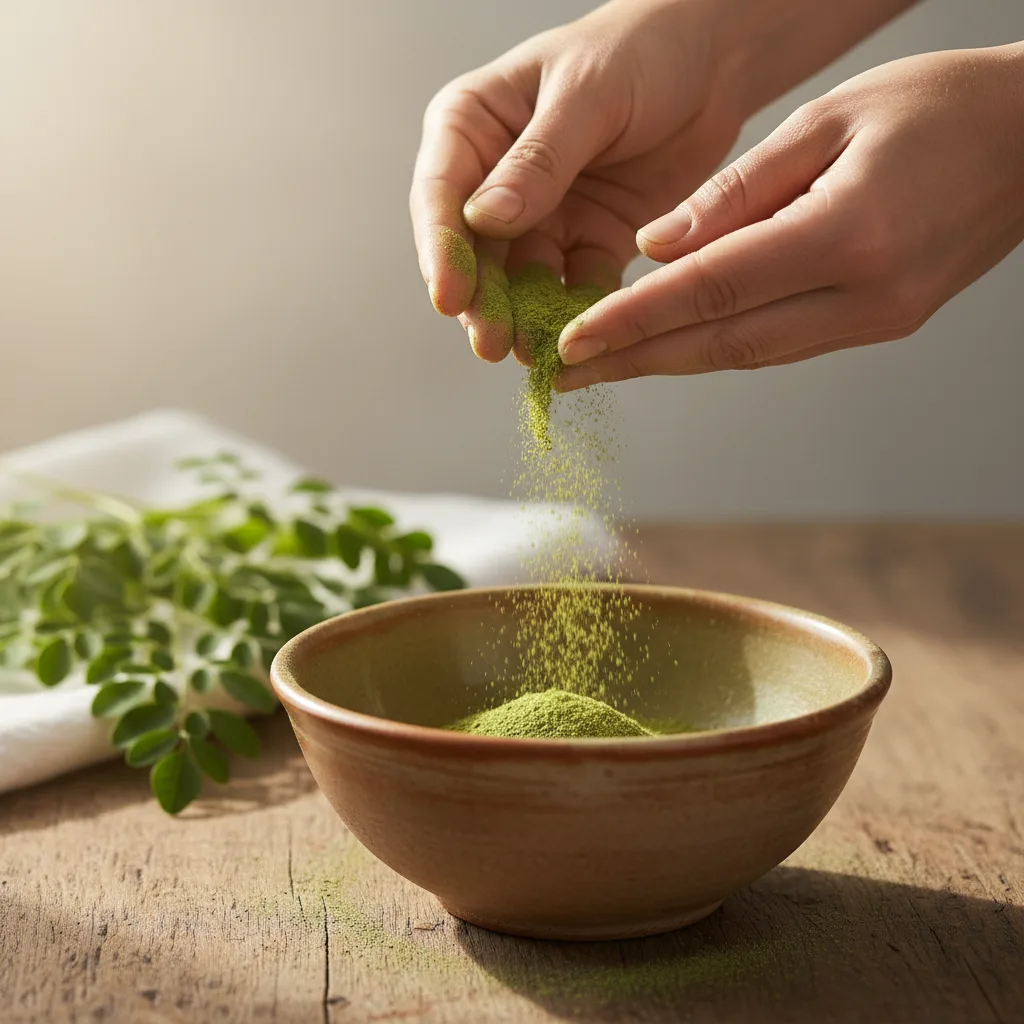
In personal care, moringa leaf powder is selected for its botanical origin and compatibility with minimal-processing claims. To meet formulators’ needs, suppliers focus on low-temperature drying, particle sizing, and standardized microbial testing. These controls support consistent texture, color, and scent profiles in topical products. Cosmetic formulators often integrate moringa powder alongside other top hair growth supplements for fuller, thicker hair and bioactive botanicals.
Formulation Tips for Skin and Hair Products
- Use cosmetic-grade powders with documented drying methods to reduce variability in color and odor.
- Confirm particulate specifications to avoid grittiness in emulsions and creams.
- Request stability and compatibility data when combining moringa powders with actives and solvents. This is especially important when seeking synergy with best teas for healthy, radiant skin and botanical infusions.
Regional Production and Demand: Guidance for Buyers
Regional strengths shape the global moringa leaf powder market. South Asia remains a production hub thanks to established cultivation networks and favorable agroclimates. East Asia emphasizes technological advances in extraction and drying, while North America and Europe focus on traceability, certification, and clean-label positioning.
South Asia: Scale and Cost-Efficiency
South Asian supply chains lead on scale, enabling competitive pricing for raw powder. Buyers should request post-harvest handling data to assess nutrient retention and contamination risk mitigation, similar to best practices set in five essential medicinal plants for 2026.
East Asia: Process Innovation
East Asian suppliers commonly adopt precision drying and extraction that preserve labile phytonutrients and support advanced ingredient formats. These capabilities are useful for formulators targeting higher bioavailability and innovative delivery, as outlined in herbal extracts market outlook 2026.
North America and Europe: Certification and Documentation
In North America and Europe, demand emphasizes organic certification, non-GMO verification, and third-party testing. These markets value transparent documentation to support clean-label claims and consumer confidence.
For regional market segmentation and forecasts relevant to procurement and strategy, see the comprehensive market dataset and projections: market forecast and dataset.
Segmentation: Raw Powder, Supplements, and Value-Added Formats
Raw moringa leaf powder remains dominant for blending and cost-sensitive applications. Meanwhile, supplements and specialty forms capture value through enhanced handling, encapsulation, and certification. Each segment has distinct procurement and quality priorities, not unlike distinctions in the licorice extract market outlook.
Raw Powder: Flexibility and Economics
Raw powder is preferred for large-scale blending and culinary use due to formulation flexibility and lower cost-per-kilo. Manufacturers prioritize batch testing and standardized moisture content to optimize shelf stability, taking a cue from approaches used in African medicinal plants for wellness trends.
Supplement and Encapsulated Forms: Consistency and Convenience
Supplement-grade powders often meet stricter particle size, moisture, and microbial standards. Encapsulation can enhance handling and protect sensitive components during storage and distribution. Supplement providers may also consider strategies detailed in inside-out wellness and organic nutricosmetics to maximize market impact.
Cosmetic-Grade and Specialty Powders
Specialty powders targeted at personal care systems have additional specs for color, odor, and fineness. These are often produced with gentle drying methods to maintain sensory and functional attributes.
Manufacturing Controls: Drying, Extraction, and Microbial Assurance
Preserving nutrient integrity starts with careful harvest timing, rapid processing, and controlled drying. Low-temperature techniques and vacuum- or freeze-drying are commonly used to reduce thermal degradation. Microbiological monitoring and sterilization approaches complement these methods to ensure consistent product safety.

Key Technical Considerations
- Drying profiles influence retention of vitamins, carotenoids, and phenolics.
- Extraction and fractionation enable formulation of standardized fractions for specific sensory or functional goals.
- Robust microbial testing and traceable supply chains reduce variability and supply risk.
Commercial and Strategic Considerations for Buyers and Developers
Procurement teams should evaluate suppliers on traceability, processing transparency, certification status, and lot-level testing. Investment in supplier audits and specification harmonization reduces quality surprises and aligns product selection with brand positioning.
Competitive Trends and Innovation Drivers
- Vertical integration helps ensure consistent seed-to-powder practices and can improve supply resilience.
- Value-added formats—such as encapsulation and cosmetic-grade powders—create differentiation opportunities for formulators.
- Sustainability claims backed by verifiable documentation increase appeal in premium markets, an increasingly important factor similar to trends in plant-based wellness for peak performance.
Practical Checklist for Selecting Moringa Leaf Powder Suppliers
- Request a Certificate of Analysis (CoA) with batch-level nutrient and microbial data.
- Confirm drying and milling methods, plus particle-size specifications.
- Verify sustainability and traceability documentation, including harvest windows and post-harvest handling.
- Evaluate packaging and storage recommendations to protect product integrity.
FAQ
-
What should formulators look for when sourcing moringa leaf powder?
Formulators should verify certificate of analysis details: moisture, particle size, microbial results, and phytonutrient markers. Also assess drying and milling methods, traceability documentation, and any certification (organic or non-GMO) required for the target market. These factors support consistent performance and supply reliability.
-
How do processing choices affect moringa powder quality?
Processing—especially drying temperature and time—significantly influences nutrient retention and color. Low-temperature or freeze-drying preserves labile compounds, while high heat can degrade some phytonutrients. Milling and screening also affect blend behavior and mouthfeel in finished products. This mirrors quality standards in the herbal tea organic rituals and bioavailable benefits space.
-
Why is traceability important for moringa leaf powder procurement?
Traceability links field practices to finished lots, helping buyers confirm sustainable sourcing, harvest timing, and post-harvest handling. Lot-level traceability simplifies root-cause analysis in quality issues and supports clean-label documentation in regulated markets.
-
Can encapsulation improve moringa powder performance in finished products?
Encapsulation can protect sensitive constituents during storage, improve handling, and provide more consistent dosing. For manufacturers, it reduces variability and helps meet specific formulation goals for shelf stability and consumer convenience.
-
What are common certifications buyers request for moringa powders?
Buyers commonly request organic certification, non-GMO verification, and third-party microbial testing. Additional sustainability or fair-trade documentation may be important for premium markets and institutional procurement, reflecting similar standards applied to traditional medicinal plants for men’s health.
-
How do regional supply differences affect product selection?
Regions differ in scale, process technology, and documentation practices. South Asia offers scale and cost advantages; East Asia emphasizes processing innovation; North America and Europe prioritize certification and documentation. Buyers should align supplier choice with product and market requirements.
-
What packaging and storage practices help preserve moringa powder quality?
Use moisture-barrier packaging, oxygen-scavenging liners where appropriate, and store powders in cool, dry conditions away from direct light. Proper palletization and humidity control during storage and transit maintain shelf integrity.
-
How can manufacturers validate a moringa powder supplier before large-scale purchase?
Validate suppliers via sample testing, review of CoAs, on-site audits or third-party inspections, and trial production runs. Confirm consistent batch results for moisture, microbial safety, and key nutrient markers before scaling procurement.
Closing Guidance and Next Steps for Procurement and Product Teams
As moringa leaf powder adoption broadens, buyers and formulators should emphasize documented processing, traceable sourcing, and format selection aligned to application needs. Use lot-level data and supplier transparency as primary decision criteria to reduce formulation risk and support consumer-facing claims.
If you need a concise segmentation and forecast to inform procurement strategy, the market dataset and projections are available here: market forecast and dataset.
Explore procurement and formulation opportunities with sustainably sourced, high-bioavailability moringa leaf powder. Prioritize suppliers with lot-level CoAs, documented drying methods, and traceability to reduce risk and support clean-label positioning. For detailed market segmentation and forecast data to inform purchasing and development decisions, consult the sector analysis: https://www.openpr.com/news/4451124/moringa-leaf-powder-market-to-reach-usd-1-120-0-million-by-2036-as
FAQs
-
What should formulators look for when sourcing moringa leaf powder?
Formulators should verify certificate of analysis details: moisture, particle size, microbial results, and phytonutrient markers. Also assess drying and milling methods, traceability documentation, and any certification (organic or non-GMO) required for the target market. These factors support consistent performance and supply reliability.
-
How do processing choices affect moringa powder quality?
Processing—especially drying temperature and time—significantly influences nutrient retention and color. Low-temperature or freeze-drying preserves labile compounds, while high heat can degrade some phytonutrients. Milling and screening also affect blend behavior and mouthfeel in finished products. This mirrors quality standards in the herbal tea organic rituals and bioavailable benefits space.
-
Why is traceability important for moringa leaf powder procurement?
Traceability links field practices to finished lots, helping buyers confirm sustainable sourcing, harvest timing, and post-harvest handling. Lot-level traceability simplifies root-cause analysis in quality issues and supports clean-label documentation in regulated markets.
-
Can encapsulation improve moringa powder performance in finished products?
Encapsulation can protect sensitive constituents during storage, improve handling, and provide more consistent dosing. For manufacturers, it reduces variability and helps meet specific formulation goals for shelf stability and consumer convenience.
-
What are common certifications buyers request for moringa powders?
Buyers commonly request organic certification, non-GMO verification, and third-party microbial testing. Additional sustainability or fair-trade documentation may be important for premium markets and institutional procurement, reflecting similar standards applied to traditional medicinal plants for men’s health.
-
How do regional supply differences affect product selection?
Regions differ in scale, process technology, and documentation practices. South Asia offers scale and cost advantages; East Asia emphasizes processing innovation; North America and Europe prioritize certification and documentation. Buyers should align supplier choice with product and market requirements.
-
What packaging and storage practices help preserve moringa powder quality?
Use moisture-barrier packaging, oxygen-scavenging liners where appropriate, and store powders in cool, dry conditions away from direct light. Proper palletization and humidity control during storage and transit maintain shelf integrity.
-
How can manufacturers validate a moringa powder supplier before large-scale purchase?
Validate suppliers via sample testing, review of CoAs, on-site audits or third-party inspections, and trial production runs. Confirm consistent batch results for moisture, microbial safety, and key nutrient markers before scaling procurement.