


Setting Up a Best Organic Moringa Processing Plant: 2026 Cost Insights, Global Demand & Sustainability
Moringa processing plant: Driving sustainable growth with efficient capacity, cost planning, and market pathways
The moringa processing plant remains a high-potential industrial initiative for botanical ingredient manufacturers and ingredient-focused food companies in 2026. This guide centers on practical investment sizing, process selection, and sustainable operations to support consistent product quality and market-ready ingredients. The content links to further market detail and cost breakdowns for planners and investors (detailed setup guide).
Plant design principles for scalable operational efficiency
Selecting the right plant design begins with a clear capacity target and a modular layout that can expand as demand grows. A moringa processing plant optimized for flow minimizes handling time, preserves ingredient quality, and reduces operational cost per kilogram.
Early layout decisions should prioritize proximity to leaf supply, energy-efficient drying, and hygienic material flow. These are key principles similar to those emphasized in the Why Moringa, Ragi, and Amla Are the Best Organic Superfoods of 2026 article.
Capital planning and realistic budgets by capacity tier
Smaller facilities (around 2,000 MT/year) typically require initial capital in the low millions due to simpler equipment and manual handling costs. Mid-sized operations (4,000–5,000 MT/year) often need USD 5–8 million, reflecting automation and lab infrastructure. Large, highly automated plants (8,000 MT+) can exceed USD 10–15 million where advanced extraction and wastewater treatment are integrated.
Resource allocation should align with market demand analysis, in line with trends highlighted in the Herbal Extracts Market Outlook 2026.
Core processing stages and equipment selection
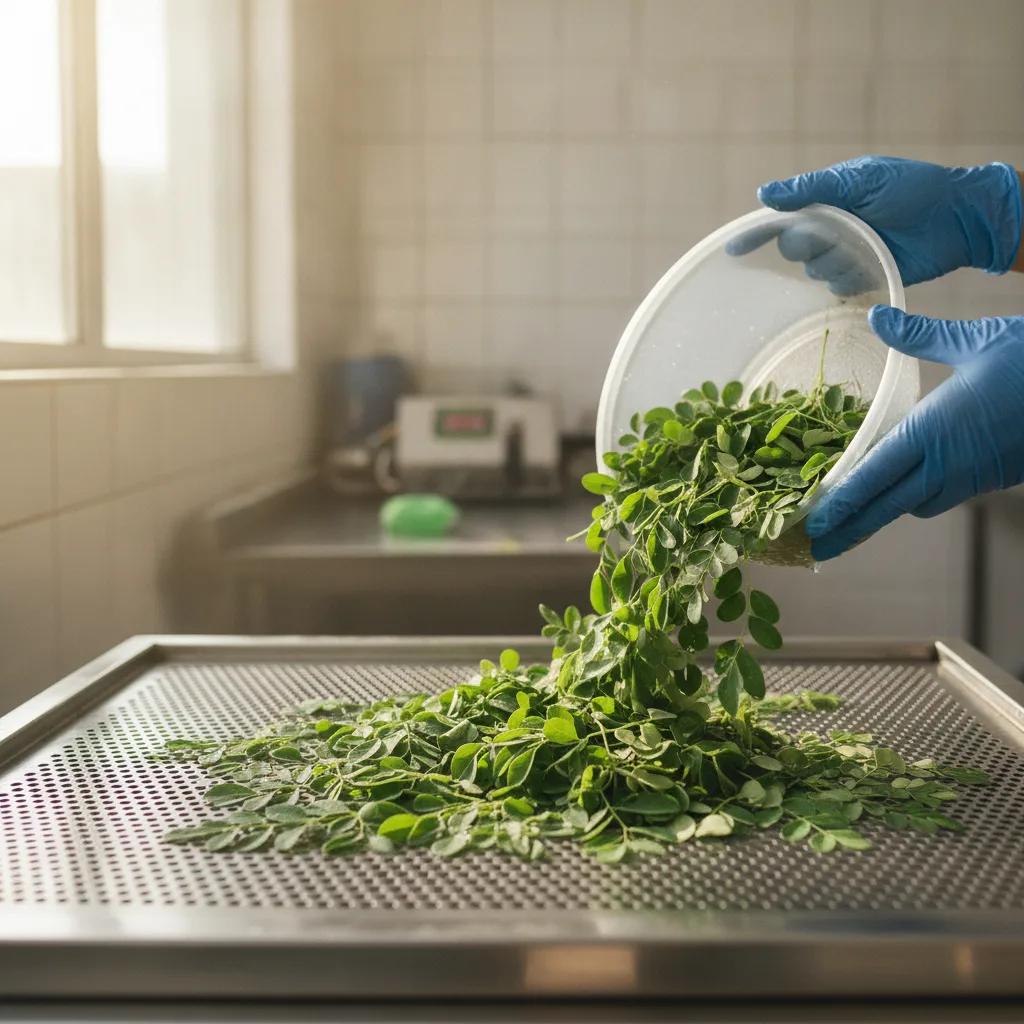
A standard processing chain includes harvest receiving, washing, sorting, controlled drying, milling, sieving, optional extraction, blending, and packaging. Choosing food-grade, corrosion-resistant stainless steel equipment and gentle thermal profiles preserves phytochemical profiles and powder color.
Typical equipment examples
- Tray or belt dryers with precise temperature control
- Closed milling systems with dust management
- Automated sieving and packaging lines
Quality from field to factory is essential—a factor that enhances the value of moringa alongside other botanical powders discussed in the Best Organic Fruit and Vegetable Capsules for Balanced Living review.
Energy optimization and water stewardship
Utilities are a significant operating cost and can be reduced through heat recovery, solar-assisted dryers, and efficient vacuum systems. Water reuse and closed-loop cleaning reduce freshwater needs and effluent volume.
Investing in energy-efficient dryers and heat exchangers reduces OpEx while supporting sustainability credentials required by organic and clean-label buyers. These sustainability strategies align with advancements in AI-Powered Natural Product Discovery: Sustainable Advancements.
Extraction approaches and solvent strategies
Extraction approach impacts product positioning and compliance. Where oil or concentrated extracts are desired, consider solvent-free cold-pressing for seed oil and CO2 or food-grade ethanol for targeted bioactives. Supercritical CO2, though capital-intensive, produces solvent-free extracts preferred by many clean-label markets.
Document solvent selection and residual testing protocols for buyer transparency and regulatory alignment, as emphasized in the analysis of MAHA Files Review 2026.
Quality management systems for market access
Implement documented SOPs from field harvest to finished goods. Batch traceability, in-line moisture monitoring, and regular laboratory checks (identity, purity, heavy metals, pesticide screens) are essential.
A strong quality system supports supply agreements and organic/non-GMO certifications, and it reduces recall risk and product variability.
Operational productivity: modular lines and digital monitoring
Modular processing units enable phased expansion and focused CAPEX spend. Digital monitoring—SCADA, OEE dashboards, and simple IoT sensors—helps maximize uptime and optimize throughput.
Preventive maintenance, staff training programs, and supplier scorecards lower long-term OpEx and maintain consistency across batches. As plant operations scale, integrating best practices can draw on experience from Bloomscrolling for Herbal Wellness.
Packaging and shelf-life for powders and oils
Packaging choices influence shelf life and application versatility. For leaf powder, high-barrier flexible pouches with oxygen absorbers preserve color and potency. For seed oil, dark glass or coated metal containers limit oxidation.
Consider single-serve dosing and bulk packaging for B2B buyers; validate shelf-life under accelerated conditions. Innovations in packaging support longer shelf life, echoing techniques within the Best Hair Growth Supplements for Men guide.
Market applications and compliant route-to-market strategies
Moringa ingredients serve multiple commercial categories: plant-forward food formulations, functional beverage inclusions, cosmetic actives (seed oil), and fortified feed components. Position ingredients by functional attributes—solubility, particle size, oil stability—rather than health claims.
Buyer-driven specifications (e.g., organic certification, particle distribution) often determine price premiums, as seen in the broader context of Exploring Nature’s Potential.
Supply-chain resilience: sourcing and farmer engagement
Secure raw-leaf supply through multi-year contracts, farmer cooperatives, or integrated farming partnerships. Farmer training on harvest timing and leaf handling dramatically improves final powder quality.
Consider seed sourcing strategies if cold-pressed oil production is planned. Traceability systems provide visibility from farm to finished product and support buyer audits—principles featured in African Medicinal Plants.
Environmental compliance and effluent management
Plan early for effluent treatment, air filtration, and solid-waste handling. Composting leaf by-products, biodigesters for organic waste, and modular membrane bioreactors for effluent can reduce environmental footprint and potential regulatory hurdles.
An environmental plan is increasingly important for organic and sustainability-minded buyers.
Financial modeling: revenue drivers, margins, and sensitivities
Revenue depends on product mix (powder, oil, extracts) and certification premiums. Typical gross margins for well-run botanical processing projects vary by market position and product mix; building sensitivity models for raw material price swings and energy cost variance is critical.
Provide transparent project assumptions when presenting to investors or lenders to support realistic ROI expectations, insights which overlap with trends observed in the Poria Cocos Extract Market Outlook 2026.
Regional siting considerations
Site selection should weigh leaf availability, labor costs, energy access, and export logistics. Regions with year-round leaf supply reduce storage needs and improve freshness. Trade agreements, port proximity, and logistics infrastructure affect landed costs for exported ingredients.
Local permitting and import/export documentation timelines should be incorporated into project scheduling.

Implementation roadmap: pilot to scale
Start with a pilot line to validate process parameters, product specifications, and packaging formats. Use the pilot phase to refine SOPs, QA checks, and supplier agreements.
Plan staged investments tied to demand signals and maintain KPIs for yield, moisture control, and defect rates to guide scale decisions.
Practical resources and next steps
For additional cost breakdowns and market-focused planning resources, refer to the expanded setup and financial analysis available here: detailed setup guide and cost models. That resource can be used alongside internal feasibility models to construct investor-ready financials.
For operational checklists and supplier selection templates, consult the same planning resource for benchmarking and regional comparatives: setup and market insights.
Ready to develop a compliant, efficient moringa processing plant in 2026?
Review the detailed setup cost breakdowns, equipment lists, and regional market data to shape your investment plan: https://www.openpr.com/news/4672199/moringa-processing-plant-setup-cost-2026-business-plan. Use that planning resource alongside internal feasibility modeling to prepare investor-ready documentation.
Key takeaways for plant investors and operators
- Define capacity and product mix before major CAPEX decisions.
- Prioritize drying, hygienic flow, and quality control to protect ingredient quality.
- Choose extraction methods and solvents aligned with buyer expectations and compliance requirements.
- Invest in energy and water efficiency early to control OpEx and meet sustainability goals.
- Maintain farmer relationships and traceability systems to stabilize supply and product quality.
This guide is intended to support operational and investment planning for a moringa processing plant. For a detailed financial model, equipment lists, and international market forecasts, review the full planning resource linked above: comprehensive plant setup analysis.
Frequently Asked Questions
1. What is the estimated capital cost to establish a mid-sized moringa processing plant in 2026?
A mid-sized moringa processing plant with roughly 4,000–5,000 MT annual capacity commonly requires USD 5–8 million in startup capital. This range typically covers land, basic civil works, processing and drying equipment, a small QC lab, and initial working capital. Regional labor, utility costs, and desired automation level can shift estimates significantly. These budget factors share similarities with those used when assessing other Herbal Extracts Market Outlook 2026.
2. Which primary processing steps are non-negotiable for quality moringa ingredients?
Critical steps include controlled harvest handling, washing and foreign-matter removal, low-temperature drying to preserve color, milling to target particle size, sieving for uniformity, and rigorous QC testing. If producing oil or concentrates, validated extraction and solvent-control protocols are also essential to maintain product integrity and buyer specifications.
3. What safer extraction options can be used instead of aggressive chemical solvents?
Safer options include cold-pressing for seed oil, supercritical CO2 extraction for solvent-free concentrates, and food-grade ethanol where appropriate. These methods reduce residual solvent concerns and often align better with clean-label and organic buyer expectations, though they require specific capital and process controls to manage cost and throughput, much like strategies explored in MAHA Files Review 2026.
4. How should a plant team plan energy and water efficiency to lower operating costs?
Implement heat recovery from drying systems, consider solar pre-heating, and use vacuum-assisted dryers to reduce energy needs. For water, prioritize closed-loop cleaning, treatment, and reuse. Early investment in efficiency yields ongoing OpEx savings and supports sustainability credentials that may command higher ingredient prices. These are consistent with methods from AI-Powered Natural Product Discovery.
5. What quality controls are most important for buyer acceptance of moringa powders?
Buyers expect specifications for moisture content, particle size distribution, microbial limits, heavy metals, and pesticide residues. Implement in-line moisture monitoring, batch traceability, and periodic third-party testing. Clear documentation and consistent test results build buyer confidence and reduce rejection risk.
6. How can an operation secure stable raw-leaf supply year-round?
Use a mix of strategies: multi-year contracts with growers, establishing cooperative networks, and seasonal inventory planning. Farmer training on harvest timing and post-harvest handling improves yield and quality. In some cases, integrating contract farming or owning satellite plots can ensure volume stability and traceability, reflecting concepts discussed in African Medicinal Plants.
7. What packaging formats are preferred by B2B food and cosmetic buyers?
For B2B buyers, bulk packaging with high-barrier liners, valve bags, or intermediate bulk containers is typical; smaller format options include resealable high-barrier pouches for retail. For oils, dark glass or coated metal drums protect against oxidation. Packaging selection should balance protection, cost, and buyer handling preferences.
8. Which regulatory and environmental permits should be planned for in project timelines?
Plan for local industrial permits, wastewater discharge authorizations, air-emissions approvals if drying/thermal systems are used, and food safety registrations. If exporting, expect additional documentation such as phytosanitary certificates and export health attestations. Begin permit planning early to avoid project delays.
9. How do modular designs reduce early capital exposure for new plants?
Modular designs let operators commission a pilot or initial capacity module, verify product specifications and market demand, then add modules as sales scale. This staged approach reduces initial CAPEX risk, accelerates time-to-revenue, and enables process refinement before larger investments. These phased expansion strategies are also discussed in the Best Hair Growth Supplements for Men guide.
10. What are practical next steps when evaluating a moringa processing plant opportunity?
Start with a market and feedstock feasibility study, develop a realistic CAPEX/OPEX model, run small-scale process trials, and secure initial supplier agreements. Use these inputs to refine investor materials or lender packages and consult detailed setup resources for benchmarking and equipment lists.